The culture of Tajikistan is an enchanting reflection of the people’s deep-seated love for the
arts, the clash of opposing worldviews absorbed by their ancestors and the rugged landscape upon
which their history has played out. Tajik culture has existed for more than two thousand years,
during which time it has absorbed many ideas from Zoroastrianism and Islam. Close ties with
Persia have also left a deep mark on the literature and arts of Tajikistan, while 20th-century
Soviet influence prompted the detailed documentation of local practices.
Tajikistan continues to maintain strong cultural ties with Iran and Uzbekistan while also
protecting the traditions of minority groups within its borders. Most notable among these are
the diverse ethnic groups who reside in near-isolation in the Pamir Mountains, although
travelers can now get acquainted with their reclusive world on a treacherous journey along the
infamous Pamir Highway.
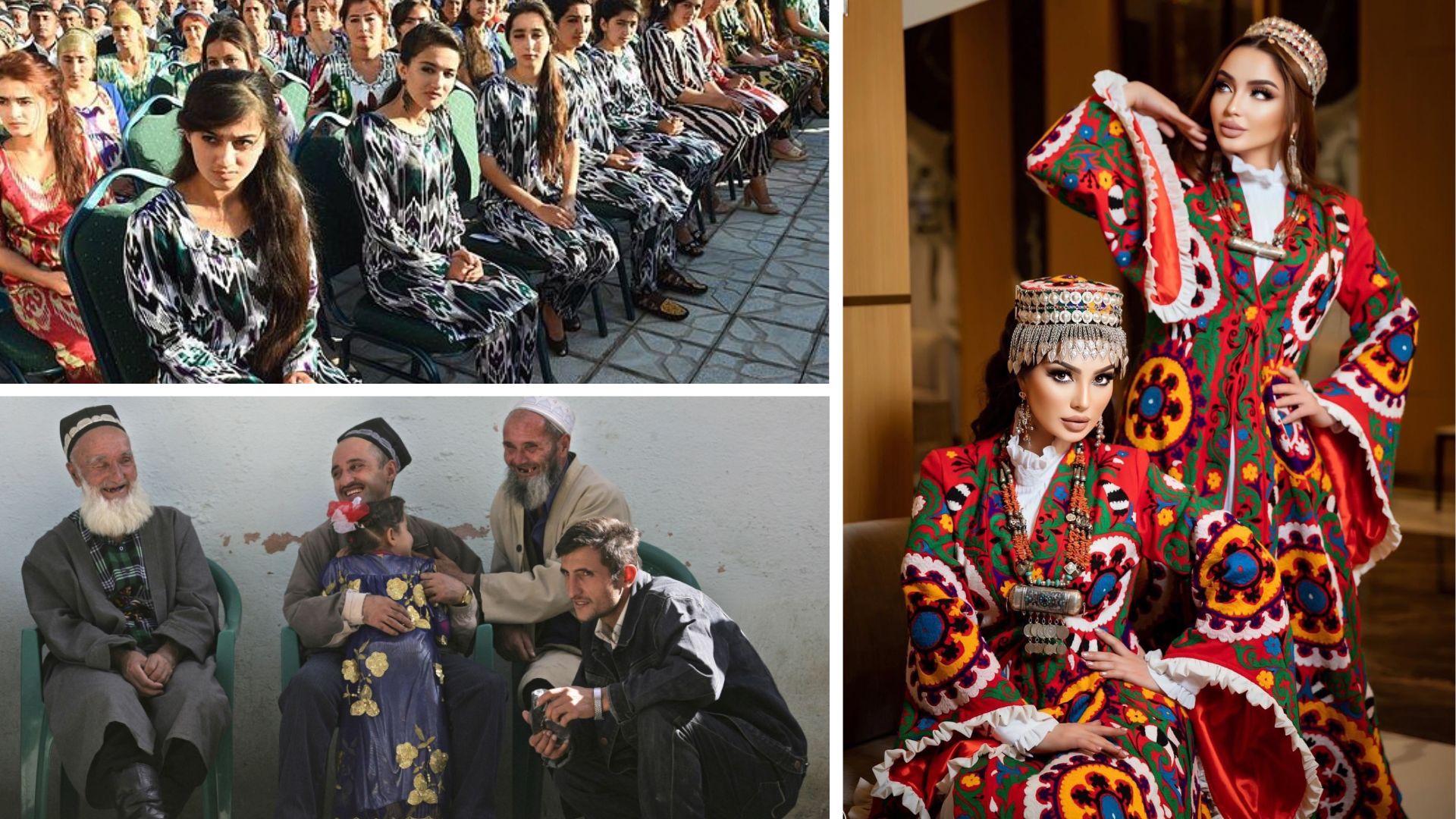
Tajikistan Clothing
Tajik national clothing is an unmistakable symbol of Tajikistan
culture which can still be seen today at national festivals, in museums and in the villages
which dot the countryside. Local clothing is defined by myriads of bright colours, straight
lines and a loose cut that hides the contours of the body.
Tajik
Men's Clothing :
Tajik national clothing for men consists of pants, a shirt, a chapan robe, belt and a turban or
skullcap, with the quality of each article an indication of the man’s wealth and status. Today,
the chapan is still worn by men at significant events such as weddings and funerals and may be
presented as a gift on special occasions.
Tajik
Women's Clothing :
Traditional Tajikistan women’s clothing consists of a dress, trousers, robe and a headdress,
although in prior centuries a burqa was also obligatory. The decorative elements and method of
tailoring each article was important, for this was used to reveal the woman’s social status.

Tajikistan Food
Tajik Meat
Dishes :
Meat is at the heart of Tajik national cuisine and is used to prepare dishes that surprise and
delight not only tourists from abroad but also guests from neighboring countries. Meat in
Tajikistan can be eaten in any form: boiled or fried, stewed or cooked in a traditional clay
oven called a tandoor. Lamb is most popular, followed by beef, horse meat (of which Tajiks are
very fond) and goat meat. Poultry is rarely served, but when it is then chicken and less often
partridge and quail meat is used.
Tajik
Dough Products :
When it comes to dough products, Tajik cuisine overlaps with its Uzbek, Kazakh and Kyrgyz
counterparts. This commonality can be seen in mantu (manty) dumplings stuffed with juicy meat
and in laghman, a tasty dish of fried meat with vegetables and noodles.
Tajik
Bread
:Tajik bread takes center stage at every meal, for without the presence of fresh, round
loaves a meal just cannot be served. Studies indicate that the average Tajikistan resident eats
up to 10 kilograms of bread per month.

Tajikistan Art
From times immemorial Tajiks have been famous for creations of national craftsmen. These skilful
hands have been making fabrics, utensils, musical instruments, carpets, furniture, jewelry and
many other things for many centuries using only natural ecologically pure raw materials.
Tajik
Crafts - Fancy Fabrics :
Zandona - it has been known since ancient times; it used to be popular in Maverannakhr‚
Khurasan‚ Iran as well as in ancient Russia and Scandinavian countries‚ China and Arabian
caliphate. The center of its manufacture was located Zandona settlement near Bukhara. During
Samanids rule it was exported to various countries; it was both uniformly dyed and patterned.
Sometimes it was ornamented by knotted weaving which laid down the basis for abr (cloud-like)
ornamentation. Zandona has survived, though in more sophisticated form.

Tajikistan Film Industry
The first film shootings on the territory of modern Tajikistan were carried out by visiting
cinematographers, amateur photographers and travelers during the first decades of 20th century
and were mostly ethnographic by nature. Similar to other former Soviet republics, the
development of the cinema in Tajikistan was associated with the State Tajikfilm Studio from its
foundation up to 1990s.
The Tajikfilm studio was founded on the premises of a small film-processing lab that
initially produced newsreels assembled monthly under the title Soviet Tajikistan. The founders
of this lab—Artem Shevich, Nikolay Gezulin and Vasiliy Kuzin—would go down in history as the
pioneers of Tajik cinema when their memorable footage of the arrival of the first train in
Dushanbe (1929) was exhibited during the proclamation of the Tajik Ssr on 16 October 1929. The
following year, the Soviet Government subsidized the renovation of the lab and established
Tajikkino,...

Tajikistan Economy
Over the last decade, Tajikistan experienced strong economic performance, with growth rate
averaging above 7.1%. Strong growth, higher wages, and international remittances helped reduce
the number of people living in poverty from 32% of the population in 2009 to an estimated 12.4%
in 2022 (at the international poverty line of $3.65/day).
Despite significant progress, Tajikistan remains vulnerable to external shocks due to high
dependency on migrant remittances, an undiversified economy, as well as high risk of debt
distress. The inflow of workers’ remittances accounts for a third of annual GDP. While public
debt is sustainable, the risk of debt distress remains high.
Tajikistan has enormous growth potential due to a young and growing population, water and
hydropower potential, and development in areas like agriculture and food processing, mineral
resources, tourism, and more.